

Interdisciplinary micro-learning programs
 |
 |
 |
 |
 |
 |
Starting from the 2020-2021 academic year, the school has been building systematic and target-oriented teaching models and learning visions based on the school’s development features. To this end, interdisciplinary micro-learning programs are established to integrate knowledge of different fields, and through the shallow-to-deep learning steps of “basic, core, application,” a second profession is cultivated along with enhanced cross-field thinking and communication, so that the students can become broad-minded talents to gain future job market advantages. There are a minimum of six credits required and up to a maximum of nine.
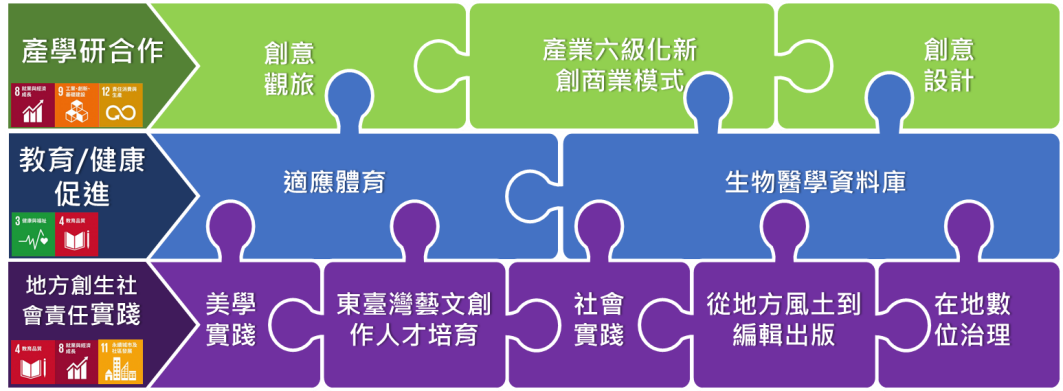
The inter-disciplinary micro-learning programs have 3 major aspects, 6 SDGs and 10 themes in the formation, including:
- Local revitalization and social responsibility practice/cultural sustainability (SDG Indicators 4, 8, 11) with 5 interdisciplinary micro-learning programs which are art and cultural talents cultivation in Eastern Taiwan, from local customs to editing and publishing, local digital governance, social practice and aesthetic practice.
- Industry-academy-research collaboration/industrial linkage and economic sustainability (SDG indicators 8, 9, 12) with 3 interdisciplinary micro-learning programs which are new business models with six-layer industrial architecture, creative design, and creative tourism.
- Education/health promotion (SDG indicators 3 and 4) with 2 interdisciplinary micro-learning programs which are adaptive sports and biomedical databases.
With 6-9 credits of exploratory courses, students can identify their own learning context and orientate their own future development, so as to achieve self-directed learning and cross-field collaboration. The first semester of the 2020 academic year had 98 students registered for the programs, and the headcount increased to 265 in 2021.
- Interdisciplinary micro-learning programs webpage: https://ctl.nttu.edu.tw/p/404-1062-106342.php?Lang=zh-tw (opens in a new window)
